
Enactive Musical Instruments
Many interactions with physical objects are physically or perceptually similar. For example, the experience of shaking a container of ice cubes shares many perceptual qualities with that of shaking a container of pebbles, or ball bearings. All are objects of a similar size and hardness, properties which give rise to similar auditory and haptic (inertial) percepts when they collide inside the container. Moreover, these similar physical properties also define the kinds of gestures that are possible. In the case of the example above, one can imagine reaching into the container and shuffling the objects or even removing some of them, or holding them in ones hand. In this sense we may say that the physics of an interaction defines its gesture space. In this work, which is carried out in the context of the European Union project Enactive, we seek to exploit the tacit knowledge of the behaviour of physical systems with well understood auditory and haptic percepts (collision, friction, etc.) to design new musical instruments. 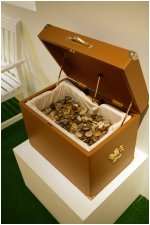
Related Publications:
- Essl, G. & O’Modhrain, S., (2006). “An Enactive Approach to the Design of New Tangible Musical Instruments” in Organised Sound, Cambridge University Press. Volume 11, Issue: 3, pp. 285-96
- Essl, G., Magnusson, C., Eriksson, J. & O’Modhrain, S., (2005). “Towards Evaluation of Performance, Control, and Preference in Physical and Virtual Sensorimotor Integration” in Proceedings of the 2nd International Conference on Enactive Interfaces (ENACTIVE’05), Genoa, Italy.
- Essl, G. & O’Modhrain, S., (2005). “Scrubber: An Interface for Friction-induced Sounds” in Proceedings of Nime’05, Vancouver, Canada
- O’Modhrain, S. & Essl, G., (2004). “PebbleBox and CrumbleBag: Tactile Interfaces for Granular Synthesis” in proceedings of NIME’04, Hamamatsu, Japan
People:
- Georg Essl
- Sile O’Modhrain