
Relay
Relay explores the concept of conveying the movement of a distant vehicle via haptic feedback to a device held in the observers hand. The project was developed to explore two scenarios, namely to provide feedback about the motion of a car in a broadcast of a formula 1 race, and secondly to provide additional cues in a vehicle teleoperation scenario.
Users engaged in Telemanipulation - the remote control of mechanical devices - typically rely on visually presented information to perform their tasks. Often they observe the actions of the device they are controlling in person, or use device-mounted cameras to provide a view of its activities. However, as the majority of telemanipulation tasks are of a physical nature, vision is arguably an unsuitable modality for the sole presentation of information in this domain. We suggest that haptics, or the sense of touch, may add significantly to the quality of a users interaction by allowing them to more directly experience the physical environment encountered by the device. We believe a sense of feeling would benefit the experience.
We use a radio controlled toy car to demonstrate this concept. Radio controlled vehicles are traditionally interfaced with a controller equipped with spring loaded levers for forward/reverse and left/right. The operator relies on observing the vehicle in order to make the decisions needed to steer it. The controlling interface offers no tactile information to the user about what forces the vehicle is ‘experiencing’. We aim to enhance the interactivity and improve the control of the vehicle by developing a handset controller which enables the user to actually feel the forces the vehicle is experiencing as it accelerates, brakes and turns.
To achieve this we have mounted accelerometers in the vehicle to measure the fluctuations in tilt, roll and yaw resulting from driving. This information about the terrain the car is traveling over is relayed to the handset via a radio link and is translated into displacement of an actuated plate in the handset. 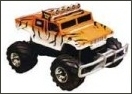
Handheld Haptic Display for Relay
This project addresses the issues of ungrounded haptic display. Force feedback devices are typically mounted to a solid object thus grounding the forces they exert. This ensures the device can output clearly defined haptic feedback. In the case of handheld devices the individual holding the device (and experiencing the forces) is also grounding the device. This can cause significant difficulties in perceiving the forces presented. This project looks at novel technologies for ungrounded haptic display. In its latest incarnation a pair of movable plates have been arranged parallel to each other. The upper plate is grounded by the heel of the hand and the lower (moving) plate is felt by the fingertips. The moving plate can be actuated to provide force displacement giving a compelling illusion of force feedback in a handheld ungrounded device.
Related Publications:
- Hughes, S., Oakley, I. Brady, A. & O’Modhrain, S., (2003). “Exploring Dynamic Haptic Cues in Vehicle Teleoperation” in proceedings of EuroHaptics 2003, Dublin, Ireland
- Brady, A., MacDonald, B., Oakley, I., Hughes, S., O’Modhrain, S., (2002). “RELAY: A Futuristic Interface for Remote Driving” in proceedings of EuroHaptics 2002, Edinburgh, UK
People:
- Andy Brady
- Ian Oakley
- Stephen Hughes
- Sile O’Modhrain